Filed under Wood Decking
Earlier this week I wrote about a couple of shots I saw that outlined the framing and preparation for a cedar deck. The shots continued to show the cedar being delivered and then installed.
There is a great video of the wood being hoisted 40′ to the roof top for the deck here: Hoist Cedar 40\’ to roof
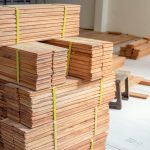
He was also fortunate to find a fork lift handy to remove his decking from the truck and get it to his hoist. Most of the time it is unloaded by hand:


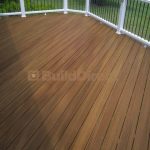
And the results:


http://www.flickr.com/photos/danebrian/2532123705/in/set-72157605113591323/
http://www.flickr.com/photos/12955651@N07/2486973876
Comments (2) Posted by Campbell Macdonald on Friday, June 20th, 2008
Filed under General Decking, Wood Decking
Comments (0) Posted by Campbell Macdonald on Wednesday, June 18th, 2008
Filed under Composite Decking, General Decking, Wood Decking
When looking at the composite decks that are available, the choice of product out there is pretty large. Considerations include colour availability, materials, warranty, dimension, coverage, span and, of course, looks.
One question I hear often is regarding hollow (engineered) deck boards vs solid deck boards: what’s going on?
The simple answer is: not a lot. Deck boards are rated for strength over spans through standardized test procedures. So whether a board is hollow or not, from a strength perspective you need to see how it is rated to make plans for spacing your joists. Hollow boards are typically engineered to more efficiently use less material to create a strong or stronger board than a solid board.
There is a visual component that concerns some regarding the look of the deck board ends. Obviously, wood decks are not hollow and the aesthetic of deck boards being solid is difficult to shake. To overcome this, there is usually a number of options for addressing this including finishing strips or fascia boards.
Some decks also require a solid board as the plans call for some to be routed. This is one application where a solid board is the only choice.
Given the similarities in application and the cost saving associated with a hollow board (less material), you may ask why solid boards are so prevalent in the North American market. The reason seems to be perception. As mentioned before, wood decks are solid and the first composite deck boards on the market were all solid. This seems to have created an image in the minds of many consumers that that is what composite decking is. Whereas, in Europe and Asia, engineered hollow boards have broad acceptance.
Comments (0) Posted by Campbell Macdonald on Wednesday, June 4th, 2008
Filed under General Decking, Railing Systems and Accesories, Wood Decking
The focus of decks tends to be deck boards, the railings that are needed on virtually every deck are often relegated to an afterthought. The reality is that railings are the most customizable and visible part of your deck. Railings also play a huge role in the safety of your deck.
So what is involved when looking at railings? There are a variety of choices available in materials alone:
- Aluminum
- Composite
- Wood (Cedar, hardwood, pressure-treated)
- Vinyl
Just to name a few. Like decking, there are pros and cons to each. Vinyl, composite and aluminum represent low to no maintenance and long term lifespans. Natural wood looks and feels great, but needs periodic maintenance. Each material also varies with cost, strength and aesthetic value.
Often customers are looking to coordinate their railing materials with their deck materials. However, this is not always the case. We have some outstanding looking decks with materials mixed and matched: Aluminum on cedar, vinyl on composite and steel on hardwood (ipe).
Next post I’ll talk about some of the labour saving you can get with different rail packages.
Comments (0) Posted by Campbell Macdonald on Monday, May 12th, 2008
Filed under General Decking, Wood Decking, wood siding
On my last blog I wrote about the various costs of the products that we sell, and one species ( in my humble opinion) deserves a lot of consideration. Western Red Cedar. This is a renewable softwood resource and relatively plentiful compared to some of the exotics and specialty woods. The decking grades BuildDirect sells are “knotty” grades that the mills select for the sound tight knots for a solid surface. We have two grades, the sound tight knot, “select”, and the “#2 and better no hole” grade, a slightly less grade and still good for one side for decking. See
As a wood, Western Red Cedar is classified as durable species, and decks can last twenty plus years with some maintenance. It has been used for roofing shingles and shakes, sidewall shingles for the cottage craftsman look, interior panelling, exterior siding in bevel, channel and board and batten, and of course Decking. The color is similar to Redwood, but not quite as red, more of a brown color and very pleasing to the eye. Interior paneling of the tongue and groove product in clear or knotty grades definitely adds character to rooms. On a historical note, Cedar has been used for centuries in the Pacific North West. See www.wrcla.org for what I think is the definitive source on this species, the Western Red Cedar Lumber Association is an extremely valuable resource for knowledge and handling of Cedar.
With Decking, the most used sizes are the 5/4 x 6 (net size is 1″ x 5 1/2″) and 2×6 (net size is 1 1/2″ x 5 1/2″) as the width is good for walking on and the wider width gives the board added strength. The 5/4 x 6 can be used to span 16″ on center, and 2×6 for a 24″ span on center. The 5/4 x 4 and the 2×4 should be limited to 12″ span.
Pricing is attractive in Cedar, it has the image of a specialty species and expensive, however I don’t think so as there are many more expensive exotics in the market. Pressure treated wood is less money, however the Pines and Hemlocks have their own characteristics and in a direct comparison, I prefer Cedar. When some of the exotic clear grades are $2.50 - 3.50 a lineal foot, the Cedar 5/4 x 6 at 1.07 and the 2×6 at 1.44 are very good value. The #2and better grade is even more of a bargain, 0.54 a lineal foot. I cannot comment on what other companies do on price, the prices on our website are our FOB mill prices and the only variable is the freight cost for home or commercial delivery.
Cedar is value.
Regards Glen
Filed under Composite Decking, General Decking, Vinyl (PVC) Decking, Wood Decking
Just another note on relative costs of products, we have many products and nowhere is there a quick summary of various products’ pricing, so here goes. This is only a guide, as of April ‘08 but gives you a comparison to work with. One item to check is the Cedar 5/4 x 6 #2and better grade, this is an outstanding value for a natural wood, no preservatives and the grade still gives a very good deck. Expect a little more trimming so adjust the wastage factor.
At the top end of the scale for performance the composites, PVC, and hardwoods are excellent as well, I cannot recommend one over the other, the customers’ preferences rule.
Price Ladder- fob warehouse or mill- all prices $us/lineal foot-
|
Ipe
|
5/4 x 6
|
$3.35
|
solid
|
|
Ipe
|
1 x 6
|
$2.58
|
solid
|
|
Ipe
|
1 x 6
|
$3.02
|
pre-grooved
|
|
Ipe
|
1 x 4
|
$1.98
|
solid
|
|
Cumaru
|
1 x 6
|
$2.29
|
pre-grooved
|
|
Cumaru
|
1 x 6
|
$2.09
|
solid
|
|
Tigerwood
|
1 x 6
|
$2.10
|
solid
|
|
PVC Quadra
|
|
$1.69
|
solid
|
|
Composite Yakima
|
|
$1.43
|
|
|
Composite Rever
|
|
$1.42
|
|
|
Western Red Cedar
|
2 x 6
|
$1.44
|
Select grade
|
|
Western Red Cedar
|
5/4 x 6
|
$1.07
|
Select grade
|
|
Western Red Cedar
|
5/4 x 4
|
$0.46
|
Select grade
|
|
Western Red Cedar
|
5/4 x 6
|
$0.54
|
#2 and better grade.
|
Regards, Glen
Filed under Wood Decking
You are building or renovating “the deck” and what materials do you decide to use. I have seen the industry change from the simple choice of Cedar or Pressure treated woods to a myriad of products. A quick recap of products would be:
- Western Red Cedar - the traditional natural choice
- Pressure treated woods
- Composite decking
- Hardwood Species- Ipe, Cumaru, Tigerwood,
I want to talk a little more about what do you do after you have made the choice of the deck surface. Some buyers now want the “matching material” however there are a lot of choices out there and we have two, hopefully more to come later. Our Lang railings are aluminum, six powder coated colors, with rails or glass panels, an easy to install system, pick your posts, rails and pickets and any accessories you need and it is finished. Our other system is Ridge, Western Red Cedar clear kiln-dried posts and rails, with either glass or black pickets. Both are excellent systems. You can find them under decking.
Regards, Glen
Filed under General Decking, Wood Decking
Natural wood decking is still a great product, many home owners now want something that is maintenance free and frankly that kind of decking does not exist. Everything has maintenance and the value equation is one of the time spent, the result and the value added to the home. One growing category in Canada and the US is the hardwood decking of Ipe, Cumaru, and Tigerwood, all of which are long lasting and durable - more so than the softwoods usually used for decking.
Maintenance options are the same as softwoods, you can leave it alone and the deck will turn gray with weathering, however simply putting on a water repellant with a UV protector can add years to the deck and keep the natural colors longer. I believe in doing this. It is money well spent to keep up the appearance of the deck as a lot of labor and money built it in the first place.
Protect the deck from grease and grime, if you have a BBQ on the deck, use some sort of matting under the deck, one customer was quite upset about BBQ grease and childrens’ spills on the deck. I sympathized but no warranty on that sort of mess and prevention is the best cure.
regards, Glen
Filed under Composite Decking, General Decking, Railing Systems and Accesories, Vinyl (PVC) Decking, Wood Decking, wood siding
On every call for decking, I get asked about shipping and delivery, and on every call the response is .. we can deliver just about anywhere. There are categories of delivery that the truckers use, these are not our rules but industry standards for the truckers. All our decking is too long for a lift-gate, with the exception of the Kon-Tiki deck tiles that are palletized. If you are a homeowner or contractor wanting delivery to the job site , this is classified as a “residential” delivery with extra time allotted for you to unload the stock. It is a manual off load, the strapping is cut and you take the boards off a couple at a time. One lift would take 2 or 3 men about 15-20 minutes, not a big job but one you have to be prepared to do. And yes, the truckers phone ahead for a delivery appointment about a day or two ahead as they will not send the truck out until that appointment has been made.
A second category is “commercial delivery” that is classified as a warehouse with a loading and unloading dock the truck can back up to. Unloading is simply pulling the pallets out of the truck with warehouse forklifts. There is a time and dollar saving here versus the residential delivery but not always enough to compensate. Usually it is better to go directly to the job site unless the order is a larger volume. ( a forklift at the job site is still a residential delivery unless you have an unloading ramp.
Our trucking partners use van type trucks for the most part, by special order for larger volumes we can do the flat beds, usually the long haul trips do not have fork lifts and having a fork lift on site would be the buyers’ responsibilities.
Before ordering, please make sure to clarify any questions regarding shipping and delivery, it can be too late when the truck is coming down the street to your house.
Regards, Glen