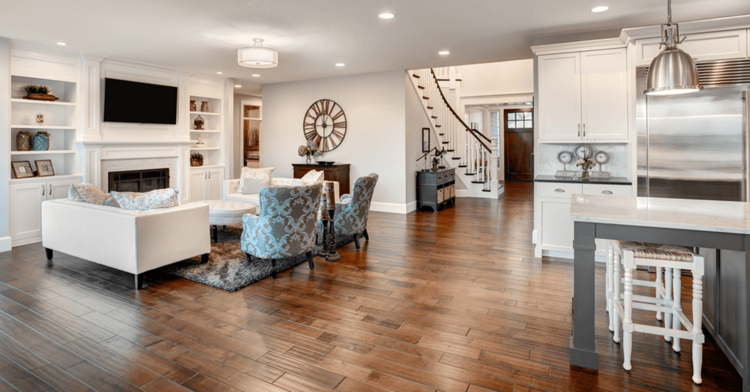
We’ve banged on and on here on this blog about how solid hardwood flooring is a big resale asset for a residence. But, according to this article in Construction Week Online, commercial contractors and designers are also gravitating towards solid wood.
Basically, the choice for flooring in commercial spaces have been largely driven by practicality. And you can understand why this is so in some ways. Floors in commercial spaces see more foot traffic than those installed in a residence. So, tile and natural stone have been the go-to choices for this reason. But, tastes have shifted as such that many commercial locations want a warmer feel, a more ‘homey’ atmosphere. So, wood flooring is beginning to pick up a bit more attention.
The prevailing issues of course are in place. Designers are still having to ask themselves ‘which species should I choose?’, just as homeowners have to do. Some of the solutions that they’re coming up with involves choosing natural stone and tile floors as accent pieces, to bolster the durability angle which I think is a great idea. But, there are a number of floors out there which are virtually comparable to stone for durability, particularly among exotic species like Jatoba and Ipe, among many others.
I should say that the article is a little harsh on laminate flooring as a solution to the question of atmosphere and visual effect. It puts forward that laminate is a ‘temporary solution’, only good for less than five years. This depends entirely on the laminate product in question, of course. There are plenty of choices in laminate floors which are designed for commerical foot traffic, rated AC4 and higher, with extensive warranties that are good for decades, not just years.
I dunno. This angle the article takes may or may not have to do with the fact that the interviewee owns a solid hardwood company who doesn’t sell laminates. You be the judge.
To that point, I know I work for a building materials company that sells a lot of wood floors and everything. But, I’m really encouraged by this trend on an aesthetic level. I really do think that wood flooring adds a certain warmth to an interior. As beautiful as a lot of tile and natural stone flooring is, wood communicates a unique first impression that says ‘welcome’.
I came across a great online community of flooring installers and enthusiasts called The Floor Pro Community . It’s a great site to get your questions answered by the folks who actually install the stuff. I’ve signed on myself so will be asking questions and giving my two cents here and there. I invite you to do the same.
Your property is a work in progress a lot of the time. Things are moving this way and that, as your space evolves according to how your expecatations of it change. This can often mean big changes. But a lot of the time, it also makes for some subtle changes too, which are just as important.
Take a look at this blog entry about patching a wood floor. In this case, a gap where a heat register grill used to be required some attention. What to do? Well, a wood floor patch as taken from another part of the property which is less viewed - the dark recesses of a closet in this case.
Take a look at the pictures. It’s not completely seamless, as the flooring which is more exposed to light tends to be less vibrant in terms of color. Yet, it’s still an attractive result, and a fairly simple workaround too without having to go out and color match for a single piece - which would have resulted in a difference in color anyway.
I guess with anything else, in this case the simplest solution was also the most effective.
Here’s an article which outlines all there is to know (well, the basics anyway) abouthardwood floor fastening. In addition to some basic ‘how-to’ information, the article also talks a little bit about the history of fastening, that before the 1950s, everything was done manually.
This is contrasted with pneumatic fastening machines and nail guns which allow the user to set the depth of a nail or screw in a hardwood floor. We’ve come a long way!
Youtube is a bit of an addiction of mine. I spend a lot of time there on my off-hours, mostly looking for footage of musicians playing live so that I can blather about it on my music geek blog. But, sometimes I peruse the vast richness of youtube because I’m also interested in the process of installing hardwood flooring, the methods of which tend to differ internationally.
Here’s a video of a hardwood wood flooring installation carried out in New Zealand by local firm Just Hardwood Flooring:
One thing that struck me was that they were installing a hardwood floor on a concrete slab, which I’ve always assumed couldn’t be done. But when they say this, they just assume that a parquet subfloor installed over a vapor barrier layer (which in this case is an applied resin to the concrete…) is included in the process. From here, they fasten the hardwood flooring boards to the wood subfloor, which is in turn fastened to the concrete slab.
What they also mention in the comments section of this video they’ve posted is that most houses in Australia and New Zealand are built on concrete slabs. So, this method is pretty common practice there. It reminds me that geography plays a huge part when it comes to choosing a type of flooring, and in installing hardwood flooring in a given space.
What do you think, good people? How does your geographical location affect your own projects?
Renovations can be messy. So, here’s a link to an article about keeping your home clean and free of dust during those times when you’re in the process of transforming a space. The article concentrates on drywall, but I think the advice can also apply to hardwood flooring.
This type of advice can come in handy, especially when you’re re-finishing hardwood floors. It’s noisy, messy, but worth doing correctly. And this is not just about making sure that your new unfinished hardwood floors, or the old ones which you’re refinishing, are sanded so that they’ll properly absorb the finish you’ll be applying. It’s also about trying to minimize the presence of dust in general for air quality and general cleanliness as you work.
A couple of important points the article covers which can be applied to re-finishing hardwood floors is:
Whenever possible, completely seal off the room in which you’ll be sanding
Rent the right equipment, including a sander which includes a vacuum attachment to minimize dust while the sanding process is underway
Keep your equipment in a specific area when not in use
Wear coveralls that you can remove after you’ve finished working, and keep it with your other equipment
Keep the air moving - use fans in your space, and open the windows. It might help to turn off your central air, to avoid any dust particles circulating in other areas of your property too
Just a few pointers when re-finishing hardwood floors, folks - I hope they, and the attached article, are helpful.
Cheers,
Rob.
Sanding hardwood flooring image courtesy of Meja Design
In this particular instance, the family involved was renovating most of their house, putting engineered wood flooring everywhere, except their bathrooms and other wet areas (good choice! wood and moisture are sworn enemies…). The family chose dark, distressed engineered flooring, which is a continuing trend.
The piece talks a bit about the trend towards engineered wood flooring in general actually, but I think the more valuable bits of information center around how to prepare for an installation when you’ve hired contractors. When you’re getting ready to go about installing engineered wood flooring when involving the professionals, the article makes a couple of points pretty clear:
Order samples. Make sure you know how the flooring materials will actually look against other design elements in the space
Think about layout. Some like horizontal, vertical, or diagonal layout. But some layouts take more time than others. And that means potentially laying out more money.
Plan on delays to your project, which lead to extra costs for the installer’s time. When budgeting, tack a few days onto your quoted price, not including weekends
Plan on wastage, and order at least 7-10% more materials than you think you’ll need.
Another point they make is the fact that it may be worth it to budget in the services of professional cleaners, which includes duct cleaning. I think this is a pretty important aspect personally, just because both my wife and my daughter suffer from asthma. A lot of dust gets kicked up when installing wood flooring of any kind. It’s worth it to make sure the dust particles don’t hang around long term, even if you don’t have asthma.
What about you guys? Anything to add based on your own experiences? Let me know!
Now this story doesn’t deal strictly with hardwood flooring installation, but hypoallergenic surfaces like hardwood are often (more and more often these days…) part of the package when looking to replace a property that has lived beyond it’s prime. I found this story about builder Rick Merlini, a builder who prides himself as someone who gets the job done quickly - very, very quickly.
Merlini has played a pivotal role in the success of ABCs Extreme Makeover: Home Edition. If you’ve never seen the program, the premise is simple: take one needy family with a home that is falling around their ears, send them on vacation, and replace the old n’ busted house with a sparkly new one while they’re gone, most often with hardwood flooring I’ve noticed, in one week. That takes an awful lot of expertise and planning. And Merlini specializes in another key factor to the success of a job like that: time management.
It’s this kind of dedication to planning that allows him to install hardwood flooring in 8 hours! Most people can make that sort of time with laminate, of course. But, hardwood flooring is another matter entirely; measuring, measuring again, cutting, and nailing to a subfloor is intense work, even without that kind of tight timeline. Yet, in Merlini’s case, that job is just one of many to complete a project in time for the family to return.
The show is currently filming locally in Charlotte North Carolina, with the program running some time in the fall.
A lot of customers contact me asking wether a vapor retarder is really necessary when glueing down an engineered floor to a concrete subfloor. In my opinion, absolutely.
In general, manufacture warranties require a vapor retarder only if the calcium chloride reading is greater than 3lbs. However, only a tiny percentage of homes in North America feedback calcium chloride readings within these requirements. Moreover, concrete emits moisture throughout its life as it adjusts to the changing climate that surrounds it. As such, a reading taken one season may be significantly different the following season. For these reasons, it is strongly recommended that a vapor retarder is applied.
To further this point, in February of this year I attended a NWFA course titled Introduction to Wood Flooring lead by Steve Marley, Techinical Director at Johnson Premium Hardwood Flooring. The course was geared towards beginners but was attended by installers ranging in experience of 1-15 years. Steve himself has been involved with hardwood flooring in one capacity or another for over two decades. Even though the NWFA does not require a vapor retarder for concrete with a calcium chloride reading greater than 3lbs, he won’t install over concrete without one and stongly advised to all in attendence to do the same. Good enough for me.
Cheers,
I just came across an article about a green building contractor and retail outlet on the Richmond.com site. The firm is based in Richmond Virginia called EcoLogic. The business is owned and operated by Stephanie and Fred Ackerman, concentrating on a turn-key solution for clients who need services ranging from design to renovation, to construction.
One of the things mentioned in the article is the need for homeowners to find alternative materials to use in renovations to their homes. More to the point, people are looking for materials which will reduce carbon footrprints, yet will also still be affordable options. Cork flooring gets a big mention, and so does reclaimed wood flooring. And bamboo flooring is a pretty big player too, of course. But, what the Ackermans found was that it’s often very hard to source these kinds of materials locally. I wonder if they’ve heard of BuildDirect? Hmmm; note to self…
In any case, this void in the local market ignited their imaginations for green building in their area. And they had a pretty practical hurdle to jump in refurbishing their premises in line with their green building philosophy. I’d encourage you to check out the EcoLogic blog, authored by co-owner Stephanie which traces the construction. It’s informative in terms of what the company is up to, but it’s also a pretty entertaining read too!
Comments (0) Posted by Rob on Thursday, July 24th, 2008
Welcome To
Choosing Hardwood Flooring
Thanks for visiting
Choosing Hardwood Flooring .
Spend sometime to look around and check
out some of our posts. We would love to hear
feedback from you, so feel free to leave comments and questions..
If you like it here, don't forget
to bookmark it (press Ctrl+D).